1-2-4-All: a brainstorming method where everyone is heard
Fifteen minutes, and every voice in the room
A simple way to brainstorm with a group of up to 20, so the quiet voices get heard and the best ideas come out. About fifteen minutes.

In most leadership meetings, a few people do most of the talking. The others have ideas too, but they won’t always say them in front of the CEO.
1-2-4-All is a simple brainstorming method that fixes that in about fifteen minutes. Everyone thinks on their own first, then shares in pairs, then in fours, then with the whole group. I’ve used it with executive teams, and it gets the more junior people’s ideas heard. Sometimes the best idea in the room comes from someone who’d never have said it in front of the CEO.
How it works
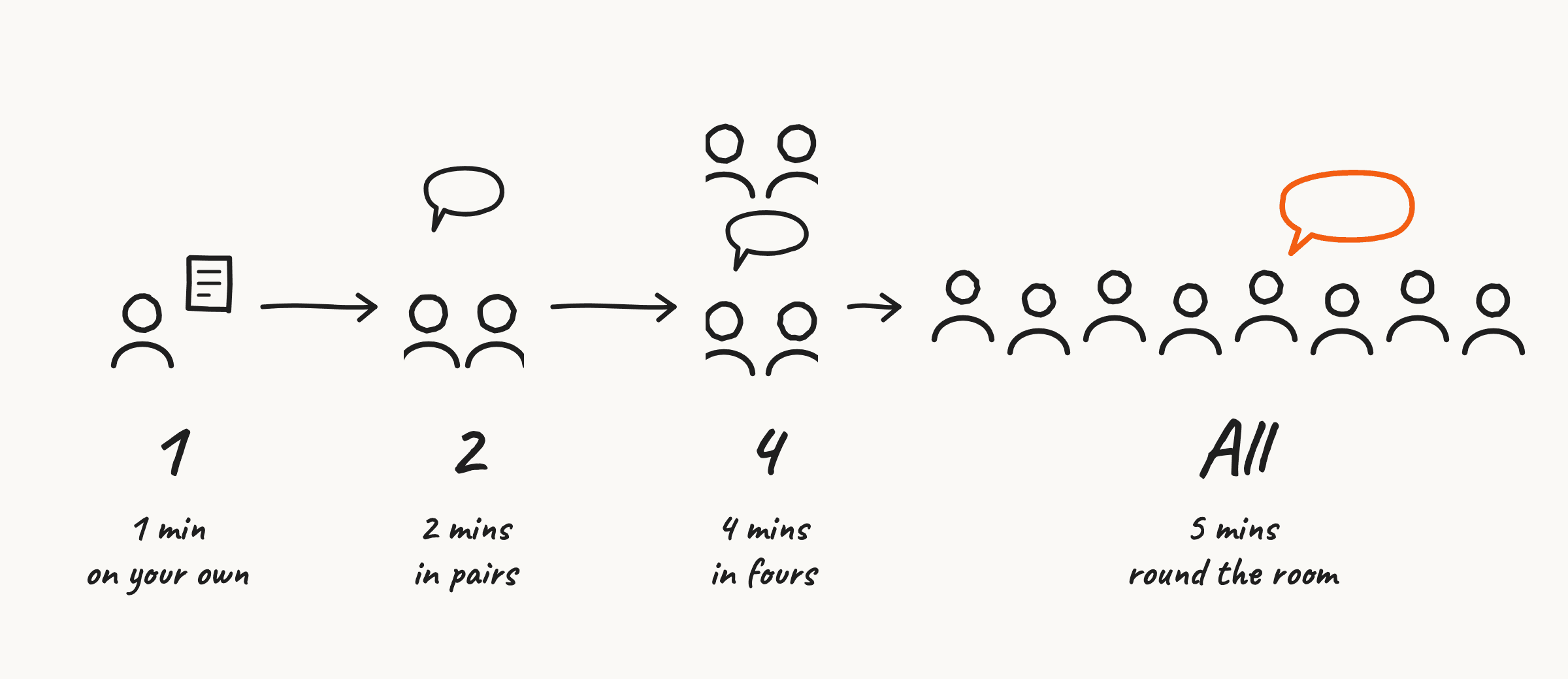
On your own, 1 minute. Pose the question, and everyone writes down their ideas.
In pairs, 2 minutes. Share your ideas. Note where you agree, and talk about what’s different or new.
In fours, 4 minutes. Two pairs join up and share what came out of their conversations.
All together, 5 minutes. Each four shares one idea that stood out, without repeating what’s already been said. Go round again while there are ideas left.
Repeat the cycle if you want to go deeper, and mix up the pairs each time.
Making it work
Keep the time tight. Use a timer with an alarm. The conversations should feel unfinished, so the energy carries into the next round.
Mix the groups. Pair quieter or more junior people with someone confident enough to speak up in the big group.
Pose the challenge in advance. Put the question in the invitation, so people arrive already thinking.
It works online, with breakout rooms. Avoid hybrid: the dynamic doesn’t work.
For bigger topics, write first
For strategies, plans or new product ideas, ask everyone to write their idea before the meeting, in half a page. Give them a template, or the writing varies too much to discuss. You can use the One Page Strategy for this.
Then run the same steps with more time: read each other’s pages, then talk. Five minutes in pairs, ten in fours, ten all together.

Then decide
Sometimes sharing the ideas is enough. When you need to land on one, you have three options: cluster the ideas and dot-vote, guide the group towards a conclusion, or decide yourself, after showing you’ve heard everyone.
Management doesn’t have to be democratic. Only hand the decision to the group if you’re willing to own what it decides.
What to use it for
Brainstorming Objectives and Key Results (see the OKR Cheat Sheet)
Choosing metrics for a weekly business review
Solving a problem together
Getting your leadership team aligned on a strategy
My guide to setting OKRs in a week uses it for most of its meetings.
What’s in the guide
Room setup, online sessions, and how to pick the groups.
Each step, with timings.
The pre-written variation for complex topics.
Three ways to converge on a decision.

The Guide
Five pages on running 1-2-4-All with your team. Free PDF, no email needed.

Where it came from
It’s based on 1-2-4-All from Liberating Structures, a collection of simple methods for getting everyone involved in a conversation.
Want help with this?
I’ve used 1-2-4-All with leadership teams as part of the strategy and planning work I do with them, so everyone in the room gets heard, not just the founder.
Leading change in a bigger organisation? Transformation →
Created by
Richard Russell
Coach for founders and leadership teams
Read next


Strategy
The One Page Strategy
A free one-page strategy template: four parts, half a page, and a way to write it with your whole leadership team.
Read →

Strategy
Why am I still the bottleneck, even though I delegate?
Every scaling founder hears 'delegate more'. It doesn't fix the founder bottleneck. A shared strategy does. Here's a test to run with your leadership team.
Read →

Strategy
Why is your transformation stuck? A 5-minute checkup
A free 5-minute checkup for leaders driving big change: where it’s stuck, what’s working, and what to try with your team this week. No email.
Read →
Know someone this would help?
Here’s a line you can send them:
Here’s a quick way to brainstorm with a group, so the quiet voices get heard.